
Biography
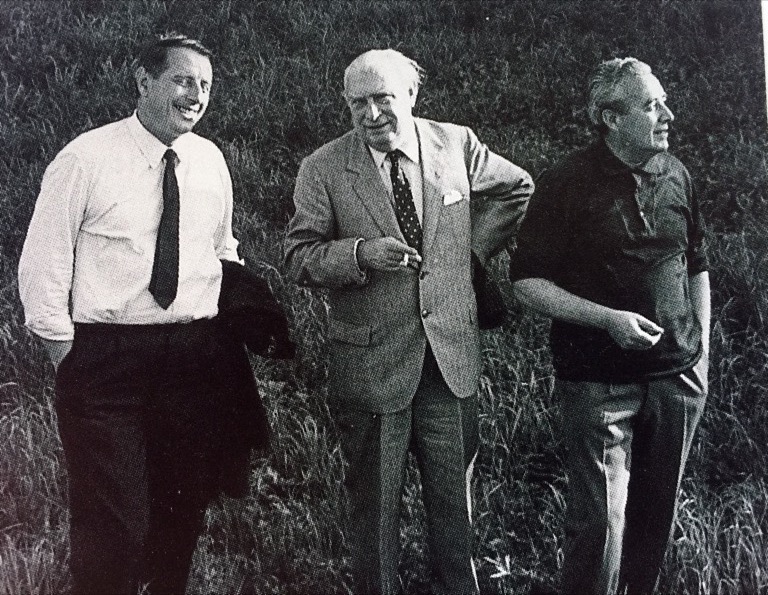
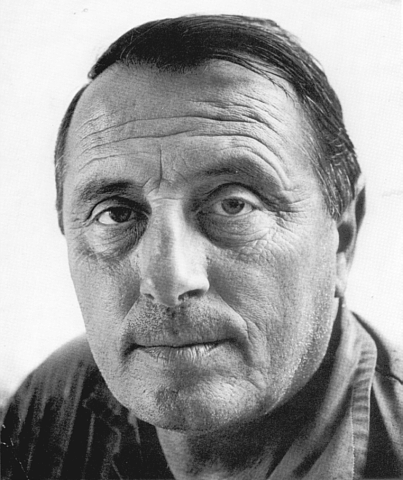
Biography
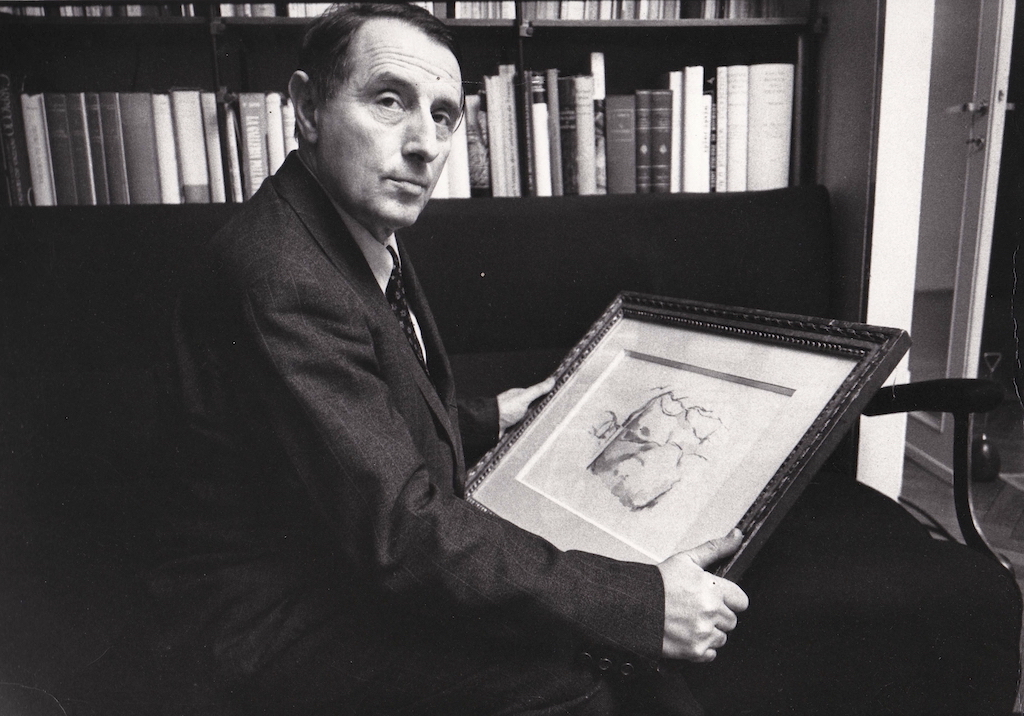
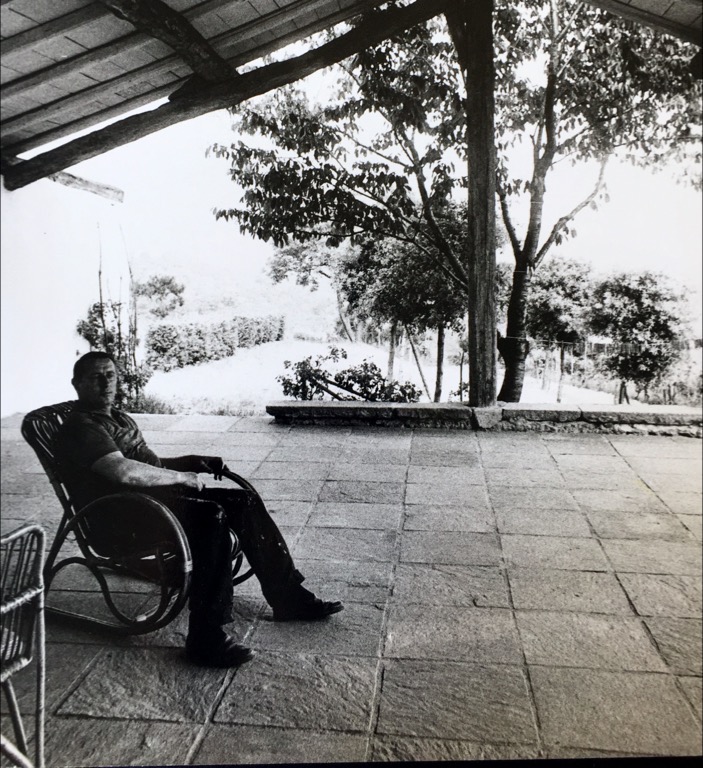
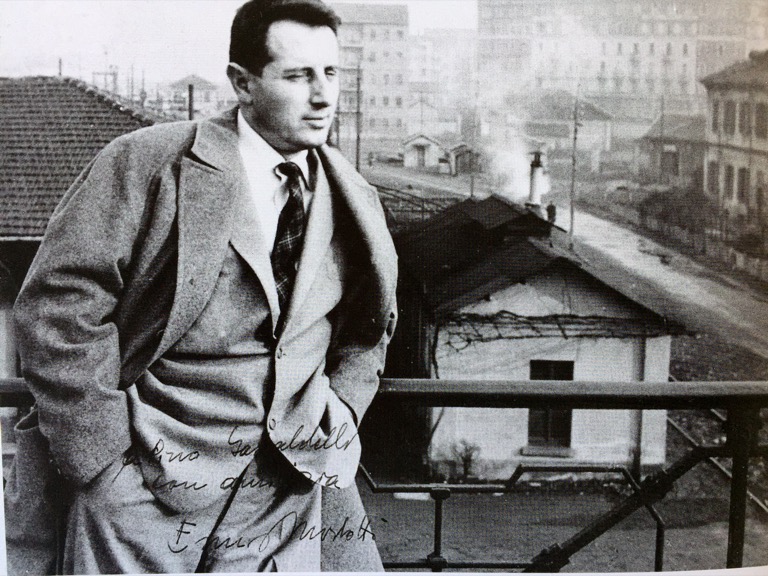
Ennio Morlotti was born in Lecco in 1910.
His fundamental life choices were not straightforward. They matured over the years doing a job to earn money for living (“But I darkly felt a rebellion inside me, that job seemed like a slow suicide […]”) and his first artistic education. Years spent in Lecco, Milan and Florence, where his temporary interests took him “I enrolled in the Academy of Florence in ’36, but I left during my second year, I couldn’t follow the lessons […] now I realise that Tuscan painting diverted the profound voice of my pictorial instinct. I am Lombard to the core”.
In ’37, Morlotti stayed in Paris for a short period and had his first direct encounter with the artworks of the great masters of the modern tradition
In Milan, from ‘39 to ‘42, Morlotti attended the Accademia di Brera.
“I had enrolled at the Accademia di Brera, where I found enormous generosity on the part of both Aldo Carpi and Achille Funi […] I think that on a human level they were very strong people, as were all of us youngsters, there was the history of anti-fascism, in short there was a true society […]”.
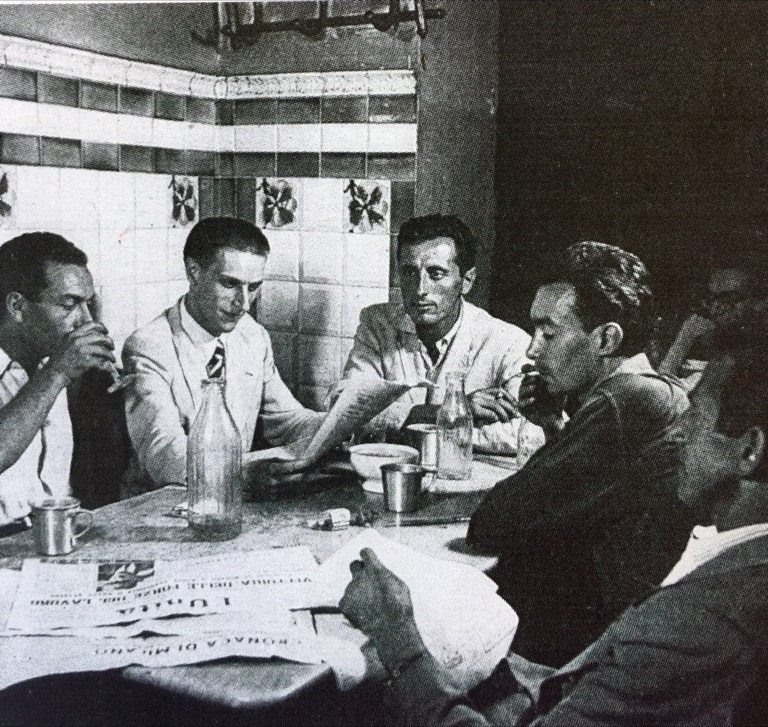
In the meantime, “Corrente di vita giovanile” was founded, a newspaper and a movement, which brought together the best minds of the time in the yearning for renewal and opposition. Morlotti joined “Corrente” in 1940.
“Despite the war and fascism, for me Milan was such a warm and generous city that it cured any and all melancholy […] I joined the Corrente movement because I felt it was a kind of ‘Scapigliatura’, an anti-Novecento, that is, nature against formalism […] a sort of revolt against our fathers… I considered Corrente to be a phoenix-like rise from the ashes, a distant source of light, the only functioning workshop of ideas, truth and opposition […] I immediately met Bruno Cassinari… then gradually Mario De Micheli, Ernesto Treccani, Beniamino Joppolo, Duilio Morosini, Renato Birolli and the others […] There was also reason for dissonance, which I kept to myself. Their loves and guides were Van Gogh, Ensor and the expressionists, I was on Cézanne’s side, despite my closed, yet turbulent and romantic nature […]. I met Alfonso Gatto, Vittorio Sereni, Elio Vittorini and Salvatore Quasimodo […] I felt I was among protagonists, among everything that acted, that thought, built and opposed […] those were my years of ‘Corrente’. I can say that they were my most fruitful and happy years”.
In ‘41 and ‘42 Morlotti took part in the Premio Bergamo (“Bergamo Award”).
His artistic orientations were clear, and he was defining on his own precise, isolated position. In ‘44 he retired to Mondonico. He had already painted intense works, in which his resentful human energy exploded within a forceful material painting, tended to trace, in a completely personal manner, the identified cornerstones of the modern European tradition.
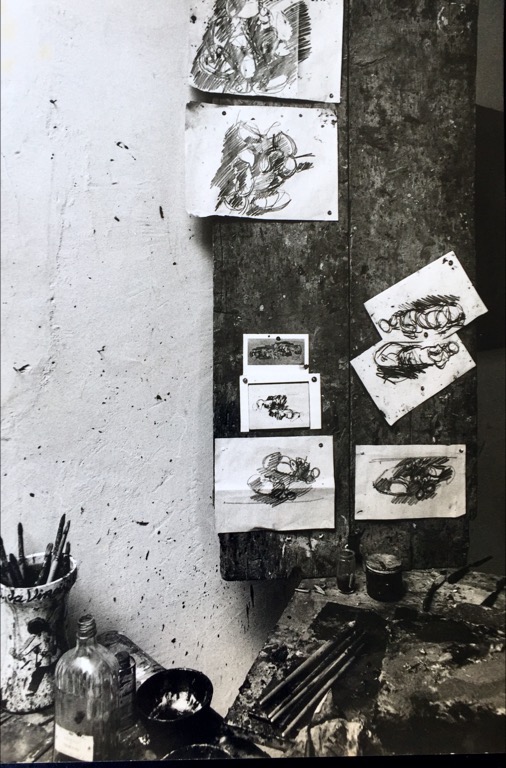
“I threw myself into a tussle with painting. Little by little I got to the Mondonico landscapes – dirty, full, geologically incandescent. It was already pre-informal painting […]. During the German occupation of Milan, I lived in Mondonico for a few months. From there, I saw the corn growing tall with swollen ears. The sound of the river took me back to my years, it was like a sound of nature urging me […] it wasn’t the tree or the house that interested me, but the sense of panic that I felt flowing in the landscape, the inner resonance of that nature. I owe a lot to my friends: Birolli, Cassinari, Guttuso, during the Corrente period. However, I also owe a lot to these aspects of nature, to the humble fact of everyday life. I wanted to manage to pour this panicked sense of life into the painting and overcome the heroic sense of rhetoric”.
The war did not pass without leaving a trace. Morlotti became insistently more inclined towards the clarification of extremes, the authentic reasons for him being a painter. Between ‘45 and ’46, he painted landscapes called Dossi (“Hummocks”), and works of strong, definitive reflection on Picasso, called La donna che si lava (“Woman washing herself”) and Le donne di Varsavia “Women of Varsavia”). He was actively involved in the cultural life of the time, collaborating with magazines – Il 45, Numero, Pittura – and, despite his instinctive aversion to all forms of abstraction, he attempted (“what I write or say seems to me a faded, inert reversal of what the long, slow work of the easel accumulated”) a theoretical clarification of his position as painter.
In ’47, he met Lionello Venturi, who got him a scholarship to study in Paris.
He went back there, for a short time, with Birolli.
“I went with great enthusiasm: but it was a great disappointment. I didn’t paint a single painting there, either. The environment was post-cubist and seemed lifeless to me […] not even a glimpse of cultural magazines. ‘Cahiers d’art’, ‘Minotaure’, ‘Verve’ had disappeared. I began to see only formalism, elegant, yet nauseating, even in the great fathers. Picasso weighed upon me like a drug, Fautrier. De Staël, Wols, Dubuffet: I didn’t understand them. Fortunately, there were also Sartre and Camus: “L’homme revolté” marked a big turning point for me. No longer directed towards society but directed towards oneself: oneself as the cause of all troubles. I felt like I had leprosy and was infecting everything. It was a seed that spread and developed very quickly inside me. Goodbye historicism, Marxism, Trotskyism, France, Russia, goodbye Voltaire, Rousseau, Diderot, society, reason, rationality, materialism, dialectic and everything else. Goodbye ‘le vent se lève’, ‘La joie de vivre’. Viendra l’heurese surprise! There was only me with my leprosy – my Picassism – which I hated like an enemy. I didn’t stay long in Paris; the projects were of no use”. .
In ’46, Morlotti temporarily joined the “Fronte Nuovo delle arti”, a movement that quickly fell apart due to disagreements between its members. He was then part of the Gruppo degli Otto, but even in this case his participation was very ephemeral “[…] even when I was in the ‘Gruppo degli Otto’, led by Lionello Venturi, I was unable to adhere to the entire position. And as soon as I grew tired, I withdrew, returning to my things, to the river, to childhood, to the light of my time”.
Morlotti’s isolation became more pronounced at the beginning of the 1950s.
Dating back to this era were paintings such as La siesta, the extreme limit of that labour of stripping of the language of modern painting from which his subsequent image emerged. In the retreat of Imbersago in Brianza, in just a few years Morlotti completed the work that we recognise as one of the most authentic and full of human values of our time. “In 1951, I accidentally came across the enchanting landscape of Imbersago. Suddenly, I remembered the hills of Mondonico, which I had completely forgotten, and that charm seduced me so much that I settled there, and there I began to paint ‘from life’ again […] I think that my story began in Imbersago: better still, the awareness of my story. At that time, a partnership with Arcangeli and Testori was born by chance: it allowed me to learn about the ‘Caravaggio problems’, and about the great Lombard painting; the awareness and esteem of Longhi, and the discovery of my roots […] an American philosopher who I discovered by chance said that even a blade of grass is born from an encounter, from a coitus […]. From then on, the sunsets disappeared, as did the horizons, the landscapes. I stopped to observe the ‘details’ of nature. Apples on an apple tree, cob on the corn and insects that crowded the subsoil intrigued me. I began to feel something secret and very mysterious. Reality, behind things; a background and a gravity all around: and something I had never felt, participation in these things. I went through a few years of solitary, passionate work; without projects, without expectations […] I was very close, without realising, to that which Bigongiari calls ‘living organism’”.
In 1954, the artist displayed five large figure paintings, which were later destroyed, at the XXVII Biennale di Venezia.
They were the announcement of the kind of poetics which affirms the identity of figure and landscape, an impetuous metaphor of his idea of painting as involvement, as being in things. Morlotti’s relationships with European Informalism existed simply as his consonance with the time, as an adherence to an intuition that makes a clean sweep of every pre-established display of value, of every already existing form “[…] I was also strangely close to the true heroes of my generation, all folded in the adventure of the organic and the living: Gorky, De Staël, Pollock […]. I could be defined as informal if one takes into account the coincidence that it established, in painting, with the value of instinct. To me it seemed the revolt of life against beautiful things, overly systematic ideas. I felt attracted to a romantic impulse. I wanted to become involved in nature, rather than start looking at it and painting it from the outside […]. I did not care about the means in order to achieve my image. I sank into the material to achieve a clarity of language”..
At the height of the dense season of the fifties, Morlotti shifted his interest to the Ligurian landscape. The encounter was prepared by the internal movements of the artist’s language: it assumed that “external point of view” (P.G. Castagnoli) that his previous experience had negated. It was the rediscovery of a dimension of distance from the image after the involvement that characterised the previous work. “I understood that that abundance of colour […] altered the sense of what I wanted to establish. I wanted, and want, to achieve my aspirations of organic density […] but now I try not to let myself drown in matter […]. It is still the sense of the organic that expresses itself in those landscapes. In Liguria, I came across a beautiful, mysterious undergrowth by chance, different from the nature I saw in Brianza and I began to paint that mystery […]”.
Between ‘70 and ‘75, Morlotti painted large paintings of figures, culminating in the painting Ricordo di Hölderlin (“Rememberance of Hölderlin”): a comprehensive expression of the motif of the figure and the landscape belonging to the formative humus of painting. Between 1970 and 1977, the series of the Teschi (“Skulls”) was created, while at the same time, starting in ‘75, Morlotti began painting using the theme of the Rocce (“Rocks”). His image seems to distance itself from his interests in the organic. “[…] I made the Teschi in commemoration of my friends, such as Arcangeli, like that, and I saw that I was stripping reality of this sap, this vegetation, I don’t know, about this living flesh, so I got to both the ‘Teschi’ and the ‘Rocce’ […]. I had a very simple palette, very used to this green tone that I was good at […] so I wanted to go back to whites, to yellows […] it was very difficult for me, and I am still in this bind that I want to escape from, because my dream is to reach the light, the hallucination, that burns everything, I have to get a little closer to death”..
A new expressive dimension developed in Morlotti’s work on the theme of rocks, that opened up his following painting
“I also developed this emotion for Rocks because a certain series of Vegetations to which I was attached for physiological reasons had run out, I believed a lot in the organic […] so, at that time, I had chased the dream of the living organic […] but for two years I had been lingering on retracing usual patterns […]. As always happens in these moments, not only did I not want to give up, but I even thought of repairing, of making up for an unsatisfactory, inadequate past, and here too, as always, I had to abandon and fall back, and what’s more on the inorganic. At that time, I remembered a place above Bordighera that from afar had always enchanted me, but I had never gone there. I reached it via a steep path, it was just a few boulders that shone, glimmering and stunning, in the morning sun. I managed to make a few satisfactory small paintings and pastels, and from there on I began to be fascinated by the issue of light, which until then had been secondary. Travelling up and down the Ligurian highway, I was surprised and then enthralled by a circle of mountains between Feglino and Finale. At certain times of the day, in that great timeless space, solitary and silent, they became incandescent, and I went to live there in 1976. The beginning, as always, was difficult and I won’t mention the discouragement and difficulties. I was aware that falling back on that was a defeat, a shipwreck, a desertion; but positive aspects also emerged, later on. First of all, there was a new ghost to chase and pursue; second, a renewed love for nature, the dissolution of indifference and nihilism.
“In the meantime, let me wander and pick wild berries to extinguish the love of you on your paths, oh earth.”
Lastly, the third aspect is the analogy with an interest, a passion born in those years for Romanesque architecture, the only passion left. Certain rocks rose before me, amazed, impassive, dazzling like the churches of Plassac, Seu d’Urgell, Jumièges. In short, a new adventure was beginning”. .
The cycle of the “Rocce” was followed by a renewed interest in figures.
In the mid-eighties, Morlotti began to paint a series of Bagnanti: hey were large figures, plastic, of dense matter, pervaded by light and echoing, in their imposing structure, his love for Romanesque architecture.
““I studied everything Romanesque for its religiosity, for its simplicity… yes, I was moved by landscapes, but my late love for architecture was even stronger. Small churches with noteworthy interiors, churches with vaults. At a certain point, I liked architecture more than painting. I looked for the popular Romanesque in France, the proto-Christian church. I had a sense of noticing their great, subdued religiosity. I am not someone who goes in and prays. It has never happened to me. I regarded them as places of private restlessness”. .
At the 1988 Biennale, Morlotti’s large figures amazed the more sensitive critics due to their expressive power and the “painful, new substance” (R. Tassi) that distinguished them. Now, the artist was assiduously, passionately committed to painting the new cycle of the Bagnanti. It was a period of fervent, intense work and profound inspiration. Above all, paintings of major dimensions, compared to what Morlotti had ever made before, were produced. The last, large Bagnanti by Cézanne were not a direct reference, but undoubtedly had a part in the artist’s thinking, in his yearning to achieve the absolute fusion of figure and landscape that he had otherwise attempted in previous phases of his work. The paintings in these last years show a harmony between the fundamental themes of Morlotti’s art and even a mutated connection between the different elements of his previous language, to the point where his image arrives to a new, airy sense of space, while powerfully preserving the sense of natural places and time. Some major exhibitions unveiled the poetic heights achieved by Morlotti, and valuable critics, as usual out of the norm – Tassi and Testori, above all – welcomed the novelty of this last period of the artist with admiration.
Morlotti himself clarified the meaning of his work that developed over those years spent in Bordighera and Brianza: “They were women, figures from many years ago, that I had seen on the lake. Women in pink and blue. They are ancient subjects, they convey the history of painting, from Giorgione to Cézanne. The nude in the landscape is a fixation that I have always had. Finally, I managed to grasp it. There is no eros, but much calm… much calm. There is pleasure, but a painting of pleasure, the sensation that living in a world of harmony gives. Looking at those paintings, I saw them almost as if I were happy to live”.
Ennio Morlotti died suddenly in Milan on 15 December 1992
Gianfranco Bruno, “Biography”, in Gianfranco Bruno, Pier Giovanni Castagnoli, Donatella Biasin, “Ennio Morlotti. Catalogo ragionato dei dipinti ”, Skira, Milan, 2000.

